At a glance:
- Different cooking systems melt cheese differently, but predictable results can be achieved by using each system consistently.
- Timing, heat exposure, and melt duration are the key variables that influence cheese melt across all equipment types.
- Removing on-the-line decision-making reduces variation and delivers repeatable melt outcomes across every shift.
In Australian foodservice kitchens, burger patties are prepared on a range of cooking equipment, including flat grills, clamshells, char grills, salamanders and conveyor ovens. Each applies heat in a distinct way and must be managed accordingly to deliver a reliable Hi-Melt cheese melt during service.
When melt results vary, the cause is often process-related rather than the cheese itself. In many cases, inconsistency is due to fluctuating temperatures, timing drift, or uneven heat contact in the cooking system. Without clear controls, the same slice can melt cleanly on one order and perform differently on the next.
This article examines how common cooking equipment affects the melt of Hi-Melt cheese and outlines practical steps operators can take to control key variables and achieve consistent results.
Clamshell Grills
Fast-casual burger operations rely on clamshell grills that apply direct heat from above and below. Consistent Hi-Melt cheese melt, therefore, depends on controlling the top platen as much as the patty, because heat is applied from both directions.
Because heat is applied from two directions, intensity and exposure are higher and more concentrated. This heat delivery system can support consistent melt outcomes, but only when execution is standardised across staff.
To achieve consistency, you need to run the equipment as a fixed, repeatable system. Top and bottom platen temperatures should be set before service and left unchanged. Cheese should be added at the same point in the cook cycle, after the patty has set, but with enough cooking time to melt evenly.
Once closed, the top platen should rest naturally on the patty and remain closed for the full melt window, without lifting or adjusting mid-cycle. When heat, contact and timing are kept consistent, the clamshell delivers predictable melt outcomes.
Char Grills
Char grills introduce greater variability into the Hi-Melt cheese melt because their heat is inherently uneven. Open flames, grill grates, hot spots and flare-ups create fluctuating heat exposure across the cooking surface, even when patties are placed in the same position on the grill.
Flame intensity changes continuously during service, leading to inconsistent melt outcomes from one order to the next. Cheese exposed to sudden flare-ups may release oil or scorch, while a drop in flame intensity can prevent the same slice from melting fully.
Achieving consistent cheese melt on a char grill, therefore, requires deliberate technique. Patties are cooked over a direct flame to develop a smoky flavour, then moved to a lower-flame area of the grill, such as the edges, to finish melting the cheese using retained patty heat rather than a live flame. Briefly covering the patty with a dome or cloche further stabilises the melt by trapping heat and shielding the cheese from flare-ups.
Char grills are ideal for flavour development, but consistent cheese melt depends on controlling where and how the cheese finishes on the grill.
Flat Grills
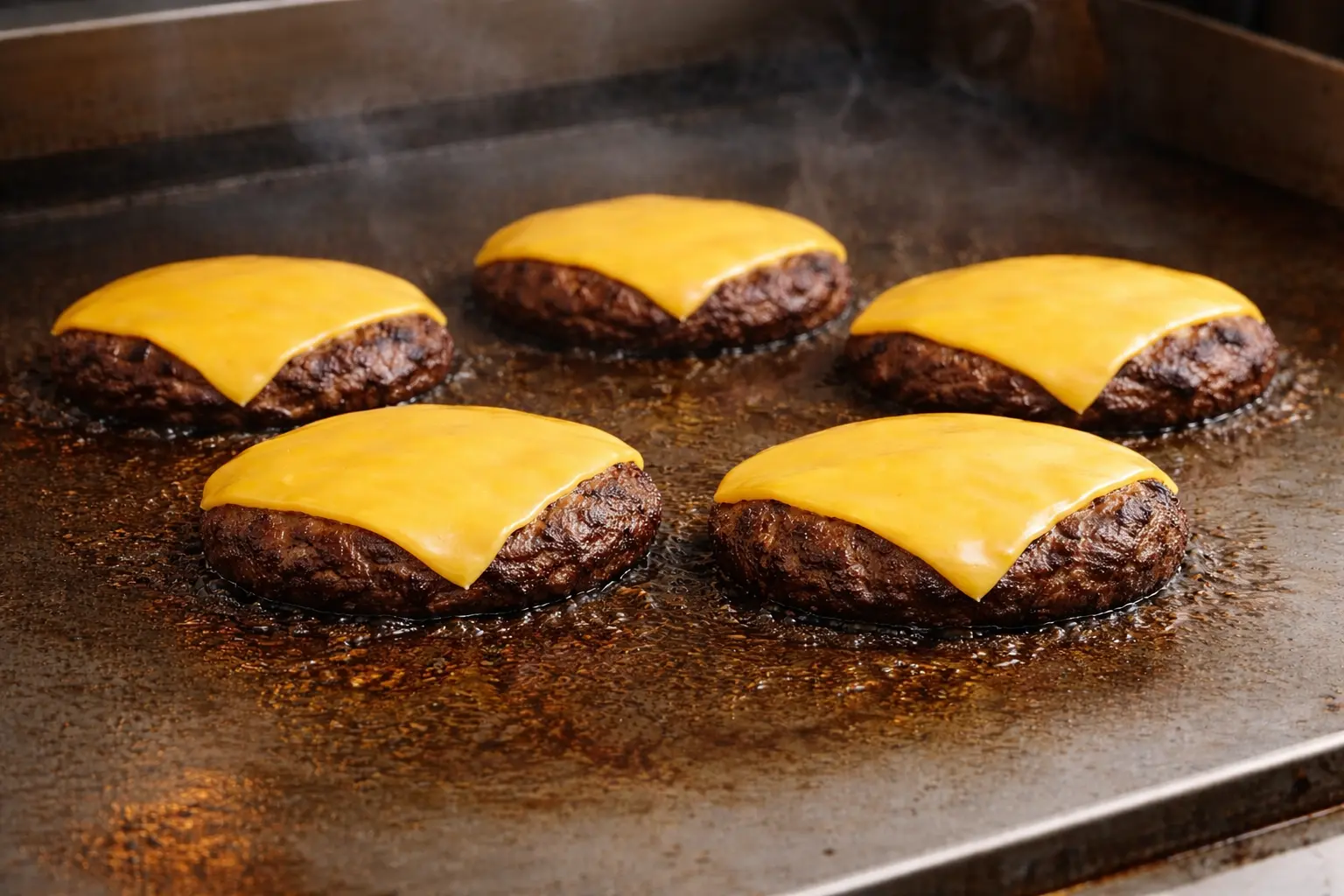
Australian pubs, cafés and casual dining venues commonly use flat grills to cook burgers. These grills apply direct, conductive heat only from below.
Therefore, cheese melt depends heavily on residual patty heat and controlled heat retention, rather than prolonged heat exposure. Inconsistent melt often occurs when these factors are left to visual judgement rather than being standardised.
To achieve consistent cheese melt on a flat grill, operators need to know when to apply the cheese. Applying cheese too early can lead to oiling off, while applying it too late can result in an incomplete melt. Establishing a fixed point in the cook cycle for cheese application removes this variability.
Heat retention is equally critical. Using a dome or cloche traps steam and ambient heat, creating a more stable melt environment. Without consistent coverage time under the dome, melt results can vary order to order, even when grill temperature remains unchanged.
Lastly, grill zoning must be managed carefully, as temperature differences across the plate mean cheese melt consistency depends on finishing the melt in a designated, stable-heat area of the grill.
Conveyor Ovens
Conveyor ovens are commonly used in high-volume burger operations to maintain consistent results at scale. Once set, the oven maintains the same heat and exposure time throughout service, reducing variation between orders.
For reliable melt results, patties should be cooked before Hi-Melt cheese is applied, and then loaded into the oven immediately. Fans circulate hot air to create consistent airflow, allowing the cheese to melt uniformly as the burger passes through the oven. With belt speed controlling heat exposure time, melt quality depends on a correct setup before service rather than in-process adjustment.
Increasing belt speed to boost output reduces melt time, leading to poor or inconsistent cheese melt. Uneven patty placement can also disrupt airflow, preventing hot air from reaching all patties evenly.
When belt speed, loading pattern and entry conditions are fixed, conveyor ovens deliver predictable, repeatable cheese melt across sustained service volumes without relying on operator judgment.
Salamanders
Salamanders are designed to finish the melting of Hi-Melt cheese rather than initiate it. They are used after the patty is fully cooked on a flat grill, a char grill or in clamshells, delivering a controlled, even melt without overcooking.
For consistent results, cooks should apply the cheese while the patty is hot, then place it in the salamander immediately. The salamander then applies intense radiant heat from above, rapidly finishing the melt while retained patty heat supports it from below. Because there is no bottom heat or contact, the patty remains unchanged.
Consistency comes from controlled heat exposure. Burgers must enter the salamander hot, be placed at a fixed rack height in the same spot, and be exposed to heat for a consistent duration. Increasing the heat instead can cause oiling, blistering or uneven softening.
Used correctly, salamanders function as a precise finishing tool that stabilises cheese melt during service, rather than compensating for variation earlier in the cook.
Whether a kitchen uses a flat grill, clamshell, char grill, salamander or conveyor oven, consistent cheese melt is achieved through standardised cooking procedures.
Cheese melts evenly when it is added at the same point in the cook cycle, exposed to the same level of heat and finished for the same amount of time. Kitchens that remove decision-making from the line achieve repeatable melt results without last-minute adjustments during service.
Hi-Melt slices from The Burger Cheese are designed to deliver stable melt behaviour across grills, salamanders, and conveyor ovens, supporting repeatable burger quality across every shift. Get in touch through our website contact form, email at info@puredairy.com, or call +61 3 9939 4000 today to order your supply.
FAQs
Does cheese melt differently depending on the type of cooking equipment used?
Yes. Different heating methods apply heat differently: conductive heat from below, radiant heat from above, or circulating hot air, which affects how quickly and evenly cheese melts. Consistent results come from adjusting processes to suit each cooking system rather than expecting identical behaviour across all equipment.
Can increasing the heat on the equipment fix a slow or incomplete cheese melt?
Increasing heat can speed up the melt, but it often creates new problems, such as oiling off, blistering, or uneven softening. Controlled heat exposure for a fixed duration is more reliable than applying higher heat to compensate for process variation.
Does staff experience level affect cheese melt consistency?
Experience can help, but reliance on individual judgment often increases variation. Kitchens that achieve consistent melt results use standardised processes that allow staff with varying levels of experience to deliver the same outcome.