At a glance
- Cheese format plays a major role in how burger restaurants manage speed, consistency, and cost control.
- Cheese slices deliver a consistent melt, precise portions, and faster service even during peak hours.
- Block cheese allows creative flexibility across broader menus but requires extra prep, which can slow service and affect portion consistency.
- Selecting the right format helps operators serve quickly, control costs, and keep every burger consistent throughout service.
Cheese defines the flavour, texture, and presentation of a burger. In busy burger restaurants, it also shapes workflow, service speed, and grill-to-counter consistency. The choice between cheese slices and block cheese goes beyond preference; it determines how efficiently a kitchen performs under pressure.
The right format can improve melt quality, portion accuracy, and overall production flow. During peak hours, it helps maintain consistent results across every serve.
This article compares the use of cheese slices and block cheese in burger restaurants and explains how the right choice supports both quality and profitability.
Cheese Slices for Burger Restaurants
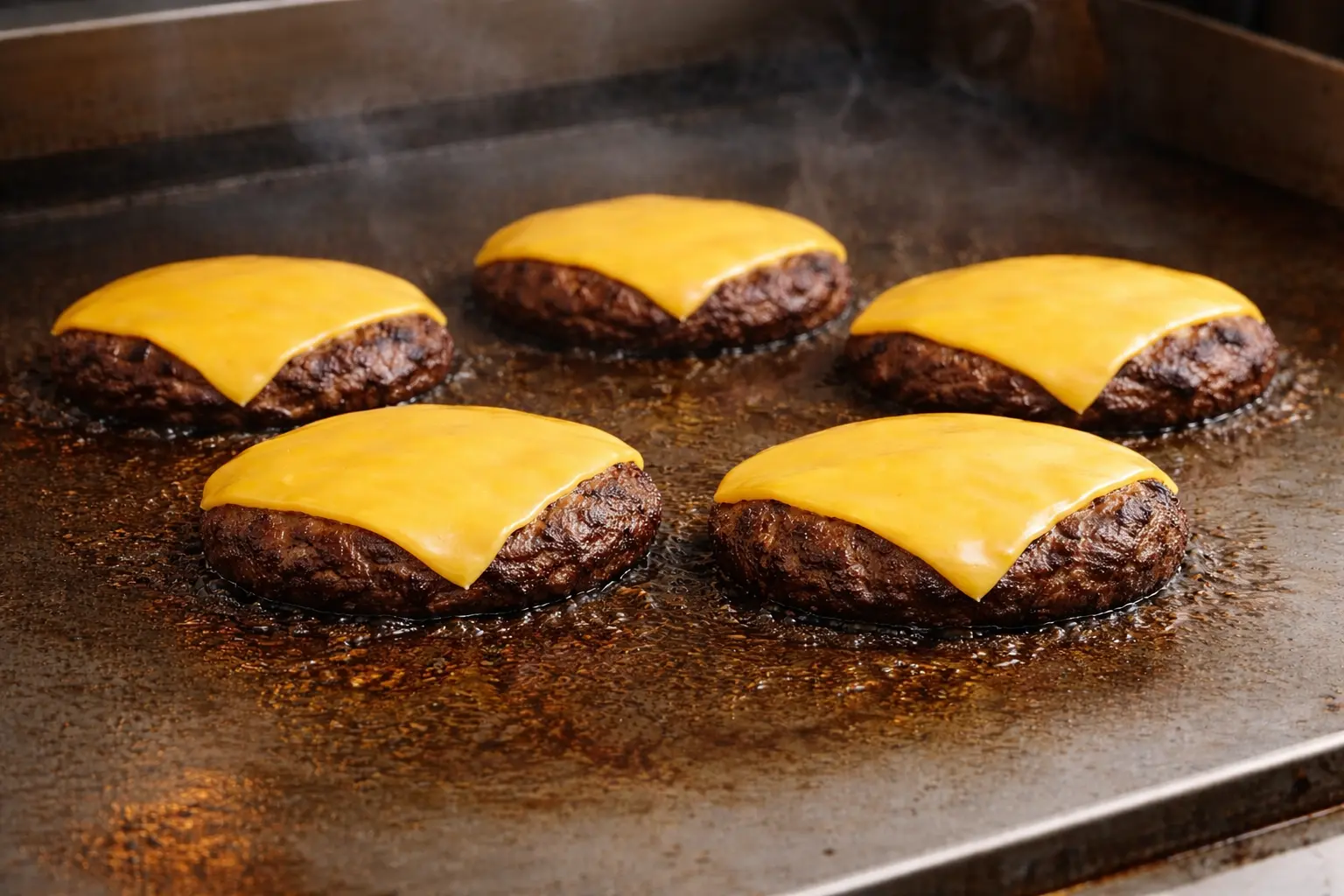
Cheese slices like The Burger Cheese’s Hi-Melt are made for efficiency in commercial burger kitchens. Pre-portioned and ready to use, they simplify prep while maintaining consistent quality at volume. Each slice is precision-cut to a standard thickness and weight, producing an even melt and dependable coverage across every patty.
Our Hi-Melt cheese slices are available in multiple formats to suit different burger builds and service styles:
- 96 slices (23.5g each, 8.89 cm x 8.89 cm): best suited for thick, gourmet-style burgers that call for a rich coverage and full bite
- 120 slices (18.9g each, 8.89 cm x 8.89 cm): a reliable choice for premium burger menus that need balanced portions and uniform results
- 160 slices (14.2g each, 7.62 cm x 7.62 cm): designed for lighter builds or double-stack burgers where clean layering and melt control are critical
- 200 slices (11.3g each, 6.98 cm x 6.98 cm): perfect for high-volume kitchens needing a thinner, cost-effective slice without sacrificing melt quality
This range allows operators to match portion size to burger build, pricing, and presentation. By removing the need for manual slicing, Hi-Melt cheese slices streamline prep, reduce waste, and maintain uniform quality across every shift. Their convenience and predictability make them ideal for fast-moving commercial environments, helping burger kitchens maintain speed and consistency during peak service.
For restaurants that rely on quick turnaround and visual consistency, The Burger Cheese Hi-Melt slices deliver dependable performance service after service.
Block Cheese in Burger Kitchens
Block cheese is supplied in large slabs, giving chefs flexibility to cut, grate, or cube it for a variety of culinary uses. It is often preferred in venues that make cheese sauces, gratins, baked dishes, or signature blends, where control over texture and cheese shape is important. Many restaurants also use block cheese to create customised toppings, mix varieties, or fine-tune flavour profiles across their menu.
In burger kitchens with broader offerings, this flexibility supports creative cooking and menu development. Chefs can portion block cheese to achieve their desired melt, incorporate it into house recipes, or experiment with different cheese combinations for varied menu items. Its adaptability makes it a valuable ingredient for chefs who prioritise creativity in preparation.
Cheese Slices vs Block Cheese: How Each Performs in a Burger Kitchen
Both cheese slices and block cheese have value in commercial kitchens, but their performance differs when applied to burgers.
The table below compares each format across the factors that most influence efficiency, cost, and quality in burger restaurants.
| Factor | Cheese Slices | Block Cheese |
| Convenience and Speed | Ready to use and pre-portioned, allowing faster burger assembly and reduced wait times during rush hours | Requires manual slicing before use, adding prep time and slowing down service during peak periods |
| Labour Efficiency and Cost Control | Minimises labour requirements and ensures predictable food costs through consistent portions | Increases labour demand and can lead to cost variation depending on portion size and cutting accuracy |
| Portion Control and Waste Reduction | Delivers precise portions every time, reducing waste and maintaining consistent burger builds | Portion sizes vary depending on who is handling them, often leading to product waste or inconsistent serving sizes |
| Hygiene and Cross-Contamination Risks | Individual slices reduce handling, improving food safety and line cleanliness | Requires more frequent handling and contact with cutting surfaces, increasing contamination risk if not managed carefully |
| Storage and Shelf-Life Efficiency | Compact packaging preserves freshness and simplifies storage rotation | Bulk blocks are prone to drying or spoilage once opened |
| Consistency across Multi-Site Operations | Guarantees uniform melt, flavour, and portioning across every outlet, essential for brand consistency | Variations in slicing or portioning across sites can result in inconsistent melt quality and presentation |
These differences highlight the impact of cheese format on burger preparation. In a burger kitchen, every second counts and consistency defines quality. Block cheese gives chefs room for creativity, but its manual slicing slows service and increases handling, which can increase contamination risks during busy shifts.
Cheese slices, by contrast, remove those variables. Their ready-to-use, pre-sliced format supports faster assembly, safer handling, and predictable cost control. During peak hours, pre-portioned slices help teams maintain speed without compromising presentation or flavour. This combination of efficiency, food safety, and reliability makes cheese slices the preferred choice for burger restaurants.
Read more: Why Hi-Melt cheese is a game-changer for QSRs
Both cheese slices and block cheese have value in foodservice, but for burger restaurants, efficiency and consistency matter most. Cheese slices deliver a uniform melt, faster preparation, and cleaner handling, removing the delays and inconsistencies that come with slicing blocks. Their ready-to-use format keeps service quick, portions accurate, and presentation consistent across every serve.
For venues built on speed and repeatable quality, like burger restaurants, cheese slices are the better choice because they combine performance, safety, and control in one reliable format.
The Burger Cheese produces high-quality Hi-Melt slices that are engineered for commercial kitchens, especially burger restaurants. Partner with us to secure a reliable supply of cheese slices that make the best burgers.
FAQs
Why are cheese slices better for burger restaurants?
Cheese slices save prep time, reduce waste, and deliver a consistent melt on every burger. Their ready-to-use format ensures faster assembly, accurate portions, and uniform presentation, which is essential for high-volume burger service.
Can block cheese be used in burgers?
Yes, but it is less efficient for burger production. Block cheese requires manual slicing, which increases prep time and can lead to uneven portions, inconsistent melting, and even contamination risks. It is better suited for applications like sauces, gratins, or mixed cheese blends.
What type of cheese slice is best for burgers?
Hi-Melt cheese slices are ideal for burgers because they retain their structure and melt evenly under high heat, preventing oil separation. They deliver smooth coverage, strong visual appeal, and dependable performance on the grill or in a warmer.
How do cheese slices improve consistency across multiple outlets?
Pre-portioned cheese slices eliminate variation between locations by providing uniform weight, thickness, and coverage. This ensures every burger looks and tastes the same, supporting brand consistency and cost control.